A manufacturer does not always need a shopping basket. Sometimes the most useful outcome is an enquiry with dimensions, a drawing and the required quantity. In other cases, customers should be able to choose a variation, pay and finish their order without a conversation. That difference is the starting point for choosing between a business website and Shopify.
My own projects provide two reference points. I develop CopperAndCraft as a product brand selling through Etsy and its own shop. For PREC-METAL, I built a website that presents a manufacturer’s range and leads customers towards an enquiry. These are my own businesses, not client case studies. Neither model is universally better: the website should support how the customer buys and how the business fulfils orders.
Can you confirm the price before a conversation?
If the customer can choose a known variation, see the final price and select delivery independently, a shop can be a natural fit. This includes made-to-order products when the specification and lead time are clear. Making an item after purchase does not, by itself, rule out online checkout.
The situation changes when price depends on drawings, tolerances, material approval, batch size or a specific transport quotation. A “buy now” button can then create uncertainty. A catalogue that explains your capabilities and gathers the information needed for a quotation may be more useful. List the questions your team asks before it can price a typical order.
When a business website is enough
A business website suits a company whose main task online is to explain its services, capabilities and relevant work. What do you make? Which materials do you process? What applications can you support? How should someone enquire? These questions can often be answered through a small number of well-planned pages.
The homepage establishes the business, service pages explain specific capabilities, project pages provide evidence and the contact page identifies the next step. Additional pages should answer distinct questions rather than simply make the website larger. A restrained structure can be easier for both visitors and the team maintaining it.
The Business Website package focuses on this presentation. Customer accounts, quoting calculators and business-system integrations are separate functions that need their own purpose and scope. They should solve a real operational problem before becoming part of the build.
When a manufacturer needs a B2B catalogue
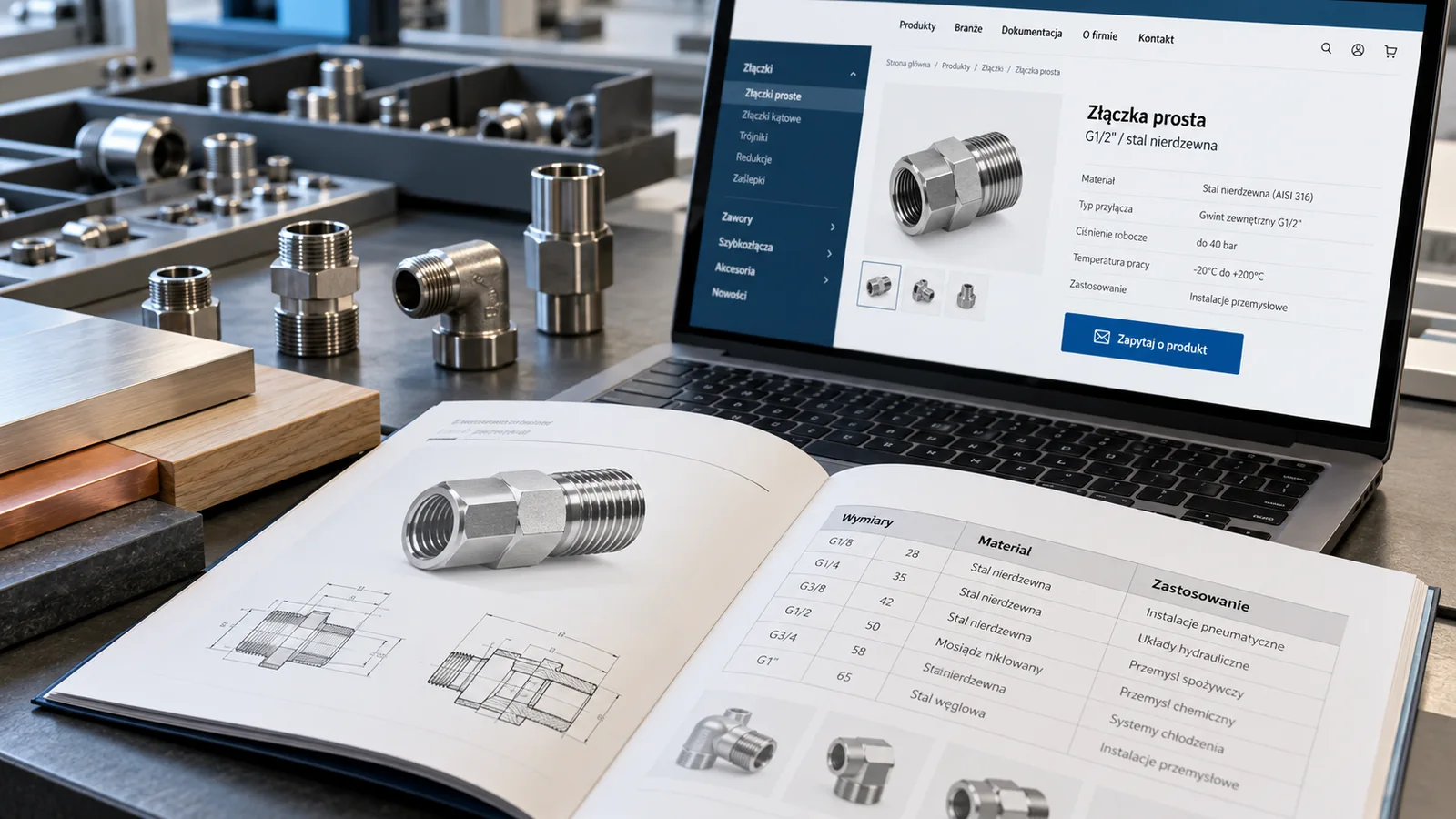
A catalogue becomes valuable when customers compare products through technical parameters. A consistent product page can show material, dimensions, connection type, available versions and application. The required fields depend on your actual range. A general template cannot decide whether a specification is technically correct.
Consistency is essential. Unlabelled changes between millimetres and centimetres, or different names for the same material, create unnecessary questions. Agree which fields are required and who approves their accuracy before designing every page. Make standard options and possible custom work clearly distinguishable.
- Name the product clearly and place it in a useful category.
- Make decisive technical parameters easy to find.
- Separate standard variations from custom specifications.
- Explain which drawings or additional details you need.
- Let customers enquire about the product they are viewing.
PREC-METAL illustrates this approach for an industrial manufacturer. The aim is to organise technical information so visitors can make a more specific enquiry. See the Manufacturer Website / B2B package for the proposed scope.
When Shopify makes sense
Shopify is worth considering when products can be ordered with understandable prices, variations and fulfilment rules. The product pages, payments, delivery options and order-management process all need to work together. An attractive theme does not make the operational decisions for you.
With CopperAndCraft, Shopify complements the existing Etsy channel. The own-domain shop provides room for collections, product knowledge and brand presentation. Photographs, finishes, sizes and interior context help people choose decorative products. Individual projects can still lead to an enquiry rather than being forced into a standard variation.
Before a build, prepare the main ordering scenarios. Which variations can be bought directly? Which destinations can you serve reliably? What happens when someone needs a bespoke size? Shopify Start provides a defined initial scope. A large catalogue or specialised integration requires separate planning.
Compare the customer journey, not just the design
| Question | Website or B2B catalogue | Shopify store |
|---|---|---|
| What happens next? | An enquiry, discussion or specification submission. | Product selection, basket and checkout. |
| When is the price known? | Often after the scope is clarified. | Usually before the order is placed. |
| Which information matters most? | Capabilities, parameters and applications. | Product, variation, price and fulfilment terms. |
| What needs ongoing attention? | Content accuracy and enquiry handling. | Also catalogue, payments, stock and orders. |
These are typical starting points, not fixed technical limits. A shop can also accept enquiries. The question is whether the additional complexity helps your customers and team. If most products require a discussion, a large checkout system may add little value. If standard repeat orders are common, handling every payment manually can become unnecessary work.
Both approaches depend on reliable product information
Prepare names, images, dimensions, materials, variations and uses. For technical products, add the details that determine whether the item is suitable. For retail products, explain what is included, how to use it and how to care for it. The buyer’s questions should determine the information, rather than the number of fields available in a system.
During the CopperAndCraft move from Etsy to Shopify, I had to organise units and formatting as well as translate descriptions. An industrial company moving from documents or an older website can face the same issue. A new design does not repair inconsistent specifications. Review a small, representative product group before applying the structure to hundreds of items.
The guide to product photography explains how different images answer different questions. Technical imagery follows the same principle: show a meaningful property rather than fill a space in the layout.
Design the enquiry process as carefully as the page
A useful B2B form can ask about the product or service, approximate quantity, key dimensions and desired timeframe. Not every field has to be compulsory. Someone exploring your capabilities may still need help choosing a material and should be able to start a conversation without a completed specification.
Decide who receives and qualifies the message, and what happens next. A submitted form, an email-link click and an order are different events. Track the outcome relevant to the business: complete, suitable enquiries may matter more than raw visitor numbers. The website needs a working response process behind it.
Separate the build from ongoing operation
Compare scope as well as price. Domain, hosting or platform subscriptions, paid applications, content updates and order handling continue after launch. Photography, specialist translations and business-system integration also need to be agreed explicitly. A low monthly bill does not mean the company has enough time to maintain a complex catalogue.
Product count is only one part of the workload. Variations, categories, missing images, translations and import checks all matter. Hundreds of products in my own CopperAndCraft project are not the scope of a basic shop package. For an existing Etsy catalogue, the migration guide helps separate store setup from catalogue preparation.
Start with a project you can clearly approve
Map the buying journey for a few typical products. Mark where the customer can act independently, where your team needs to help and when you can confirm the price. Then agree pages, languages, products, functions, materials and approval responsibilities. This is a more useful brief than a long list of features taken from competitors.
Explore business websites and B2B catalogues or Shopify services. If a marketplace is also under consideration, read Shopify vs Etsy. You can also describe your sales process: we can choose the platform and project scope around what your business and its customers actually need.
Need help with Etsy, Shopify or a business website?
Tell me about your project. I’ll reply personally.
Enquire about a consultation ↗US$90 excl. VAT / 60 minutes · By appointment