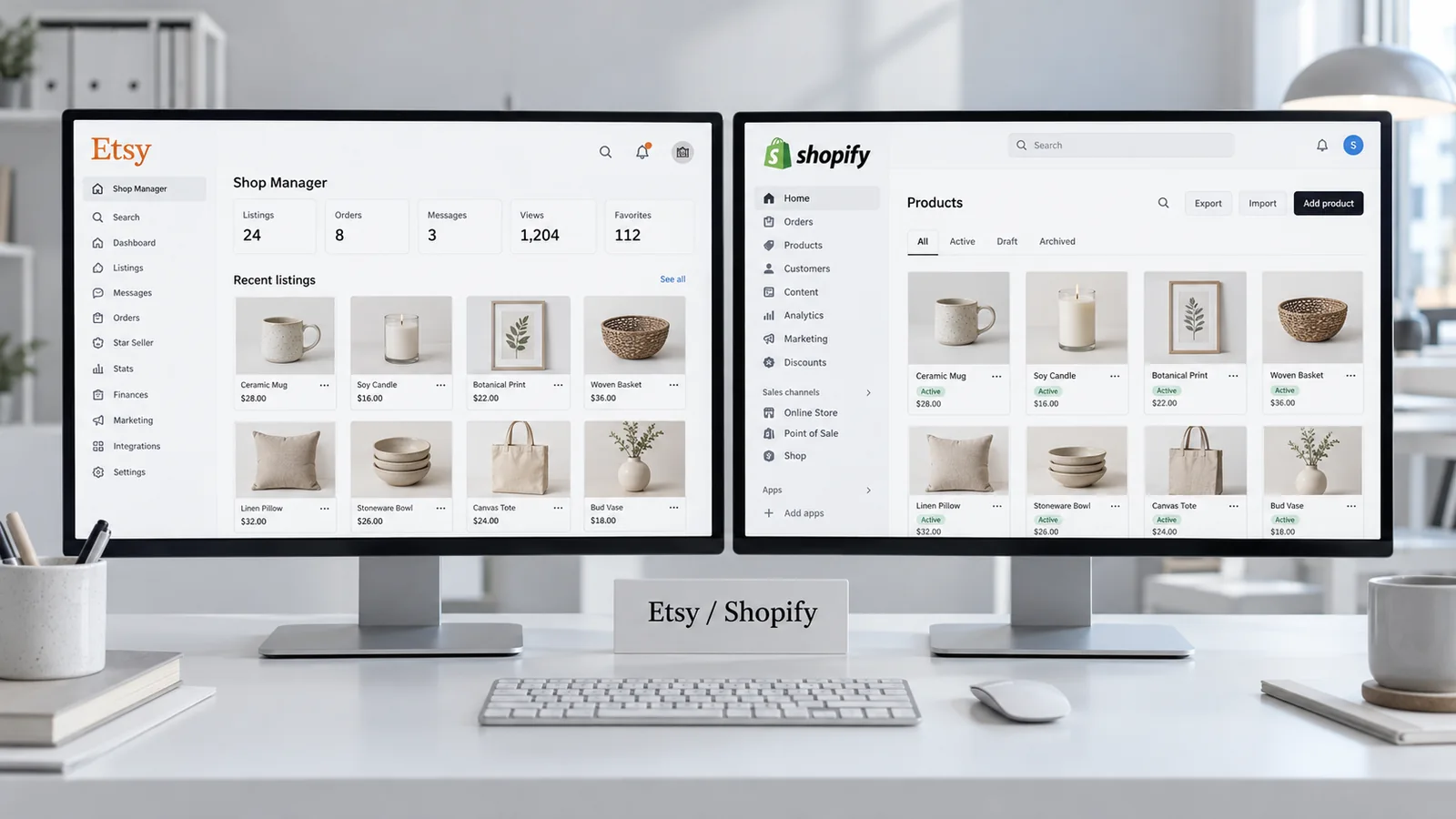
Etsy and Shopify do different jobs. Etsy lets you list products within an established marketplace. Shopify provides the tools to run your own online store. Preparing a listing quickly does not guarantee quick sales, and greater control over a website does not bring customers automatically.
The decision should start with your product, your customer and your plan for reaching them. I developed CopperAndCraft on Etsy before adding Shopify and localising the catalogue for further markets. That is my experience, not a universal formula. Here is how to assess the two channels without assuming every maker needs both from day one.
A marketplace and your own store: the main difference
On Etsy, customers browse a shared platform with many sellers. Your listing may appear alongside similar products from other brands. Presentation, search and checkout follow the platform’s structure. Fewer design decisions can help you concentrate on the products, but you have less freedom to shape the complete customer journey.
With Shopify, you organise your own navigation, collections, pages and brand content. Shopify’s online store documentation covers features including domains, themes and blogs. Those tools still need good materials and a plan for attracting visitors. Publishing a store is one step in a sales strategy.
| Consideration | Etsy | Your own Shopify store |
|---|---|---|
| Starting point | Listings within a marketplace. | A store with its own structure and domain. |
| Traffic | Potential discovery within Etsy, without a guarantee. | A plan for marketing and reaching your audience. |
| Brand presentation | Within the platform’s layout. | More control over pages, collections and presentation. |
| Costs | Listing, transaction, payment and applicable advertising fees. | Subscription, payments, domain, selected apps and marketing. |
| Day-to-day work | Managing listings and orders in Etsy. | Maintaining your catalogue, content and store settings. |
First, check whether your products fit Etsy
Being a manufacturer does not automatically make every product suitable for Etsy. Review Etsy’s Creativity Standards before comparing shop designs. What the item is and how it is made both matter. Decide based on the actual product and process, rather than the platform’s association with independent makers alone.
Then consider how the customer buys. Can they choose a variation and order without a conversation? Or do they need to send a drawing, discuss tolerances and request a batch quotation? For the second type of purchase, a clear B2B website may be the more useful starting point.
When is Etsy a reasonable first step?
Etsy is worth considering when you have a coherent range that fits the platform, supported by photographs, specifications and fulfilment terms. A smaller initial catalogue lets you focus on presenting those products to an international audience. You still need to calculate margins, shipping and the time required to answer enquiries.
For example, a ceramics studio with a few established collections might first organise its photographs, variations and descriptions for a marketplace. That is a planning example, not a forecast of demand for ceramics. Products involving extensive personalisation also need a clear process for gathering requirements and setting limits.
Etsy Start covers preparation of a new shop and its first ten listings. It does not replace Etsy’s verification of the owner or include platform fees. It suits a shop that needs an organised launch. An existing shop with specific listing problems may need an audit instead.
When does Shopify give you useful additional scope?
Shopify can make sense when you want your own domain, a fuller brand presentation and a catalogue organised around how customers choose. You may need dedicated collections, fitting instructions, advice articles or pages showing different applications. These can help returning customers find information beyond a single product listing.
Before building, identify how people will reach the store. Search content, social media, referrals, partnerships and advertising are possible sources. Choose activities you can maintain. A plan to publish daily on five channels is unlikely to be realistic if you also make every product and fulfil every order yourself.
Shopify Start covers a store with up to ten products within an agreed scope. Large imports, additional languages and unusual integrations are quoted separately. Choose themes and apps for a specific purchasing or operational need, rather than adding features simply because they are available.
Compare the full cost of operating each channel
“A marketplace is expensive; my own shop is cheap” overlooks customer acquisition and site management. The reverse is equally simplistic. For Etsy, include the applicable platform, payment and advertising fees alongside the work of preparing listings. For Shopify, include the subscription, domain, payment processing, any apps, implementation and marketing.
Count the product, packaging, shipping and your time in both scenarios. Omitting your working hours from one side makes the comparison misleading. Do not assume identical order volumes merely to produce a winner in a spreadsheet. Compare required spending and resources first, and treat sales forecasts as scenarios.
Rates depend on market, plan and services. Check Etsy’s fees policy and Shopify’s current pricing before making a decision. The Etsy startup budget guide explains the categories to include. A setup service is separate from the platform’s own charges.
More control also means more decisions
Somebody must maintain product information, navigation, available variations and current fulfilment terms in your own store. Decide who will do that after launch. Without time allocated to upkeep, even a carefully built website can become a collection of outdated information.
Etsy also requires regular attention as products, prices, availability and customer questions change. The difference is how responsibilities are divided between seller and platform. Write down the recurring weekly tasks for either option and check that they fit alongside production and order fulfilment.
When can the two channels work together?
Combining them can make sense when Etsy is established and your own store has a clear additional role: presenting a wider catalogue, serving another market or developing your own domain. Keeping Etsy open is possible, but you need a process for maintaining consistent specifications, variations, prices and lead times across both channels.
At CopperAndCraft, Etsy continued as a separate channel after Shopify launched. The source catalogue contained approximately 480–540 listings, and the work included importing products and localising their content. This illustrates the organisational scale of my project, rather than predicting results for another brand.
Decide whether updates will be manual or handled by an integration. An initial import does not establish ongoing stock or order synchronisation. A small catalogue may work with a straightforward manual process, provided someone owns it and follows it consistently. A one-off item must not be sold twice because stock information was left unchanged.
Moving products does not automatically move traffic
You can transfer a catalogue, but Etsy reviews, search positions and shop history do not automatically become assets of a new domain. Your own store needs its own traffic. “Migration without losing traffic” should therefore never be treated as a guarantee. Often the more accurate description is adding a sales channel using an existing catalogue.
The Etsy to Shopify migration guide covers importing, localisation and product checks. Agree the data scope, language, market, price conversion and sample descriptions before starting. Keep catalogue migration distinct from building the complete store: they are related tasks with potentially very different workloads.
Choose one useful next step
List what is ready: products, photographs, specifications, pricing, shipping arrangements and an initial source of visitors. Identify the biggest gap. If the offer itself is unclear, start there. If you have reliable materials and regular interest in the brand, consider your own store. If orders depend on individual quotations, revisit the B2B model.
Test your plan by describing the first month after launch. Who maintains the catalogue, answers customers and communicates with the audience? How will you assess progress? A second channel should answer a real need and fit your available resources.
If you already sell on Etsy, the appropriate next project is Shopify and, where needed, catalogue migration. There is no reason to set up the same Etsy shop again.
Need help with Etsy, Shopify or a business website?
Tell me about your project. I’ll reply personally.
Enquire about a consultation ↗US$90 excl. VAT / 60 minutes · By appointment