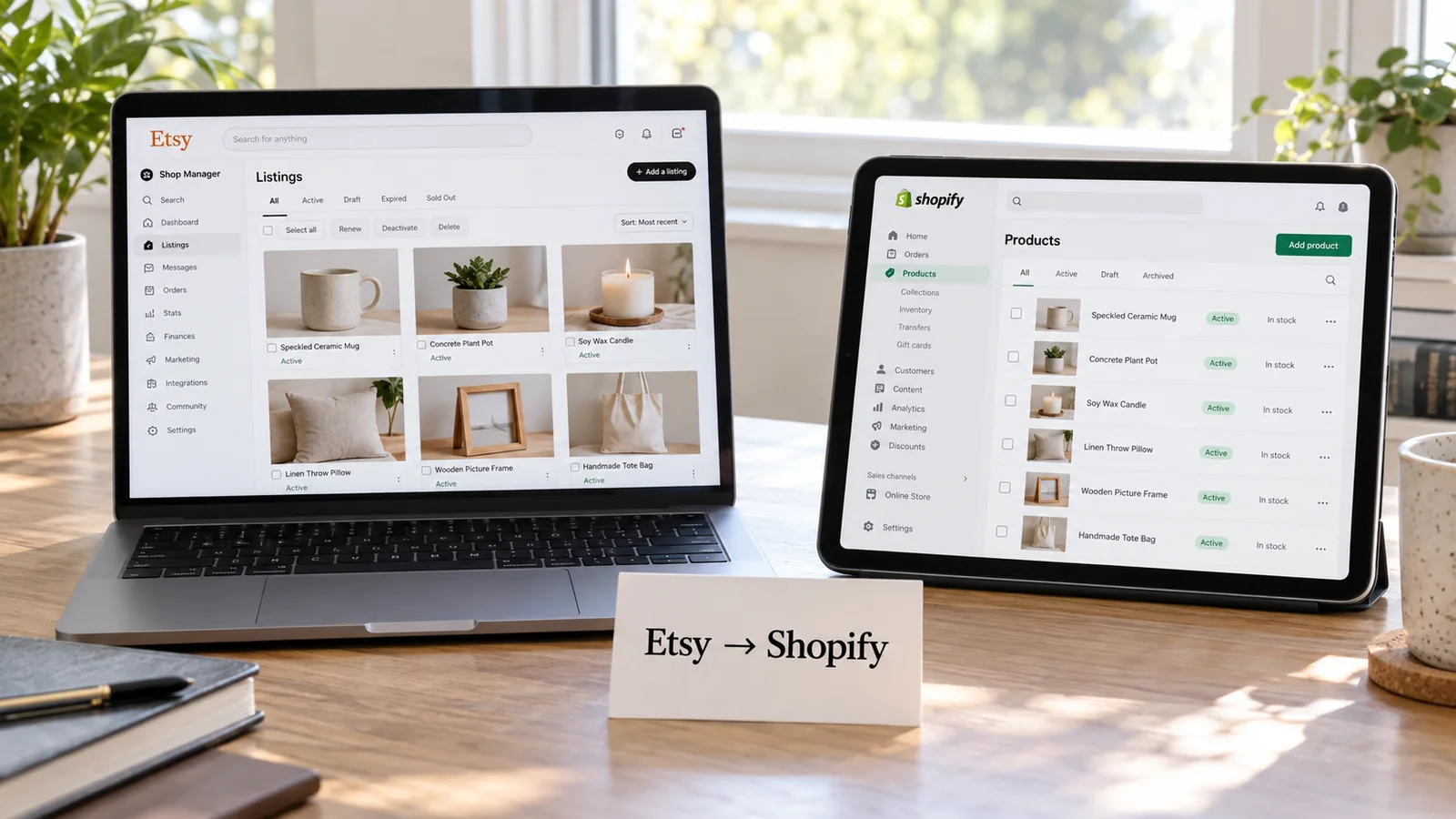
Moving an Etsy catalogue to Shopify does not automatically transfer its traffic, reviews or search rankings. You can reduce disruption by keeping a working Etsy shop active while building the new channel carefully. No product import can honestly promise the same audience on a new domain.
I followed this route with CopperAndCraft, after building the Etsy shop myself. The starting point was approximately 480–540 English-language listings, with prices in US dollars, dimensions in inches and customers mainly in the USA. The challenge was to create a consistent catalogue for new markets, rather than simply copy product pages.
Define what migration means in your project
Three separate jobs are often grouped under this word: transferring product data, building the new shop, and operating both channels afterwards. Store design, payments and shipping configuration are different from catalogue preparation. Ongoing stock or order synchronisation is another scope again. None should be assumed to come with the others.
Write down whether Etsy will remain active, which market Shopify will serve and who will maintain the data after launch. Clarify whether you need products only or other records too. Reviews, past orders and customer data have their own restrictions and requirements; a listing importer is not a complete business-history migration.
If the channel decision is still open, start with Shopify vs Etsy. A defined purpose makes it easier to decide which functions are essential and which can wait.
Take stock of the source catalogue
Create a product inventory with source identifiers, working SKUs, titles, variations, images and status. Distinguish samples, sets, archived listings and custom-made items. Similar titles can conceal very different sizes or quantities, so a reliable identifier matters more than a familiar name.
Keep a copy of the original export. Store the source description alongside the draft and approved version. With hundreds of products, memory is not a reliable way to track progress. Simple statuses such as “to import”, “to localise”, “to review” and “ready” help prevent a later bulk operation from overwriting approved work.
- Match products and variations unambiguously.
- Check image order, quality and variation assignments.
- Standardise materials, units and dimensions.
- Document currency conversion and rounding rules.
- Flag missing information before applying changes in bulk.
Test the importer on a representative sample
In my implementation, Etsy Importer transferred products and converted prices automatically. That describes the tool used for this project, not a guarantee about every application with a similar name. Before installing or paying for one, check its current scope, costs and handling of variations, images and repeated imports.
The official Shopify guide to migrating from Etsy outlines available routes. Whatever tool you choose, begin with a simple item, a set, a product with variations and a non-standard listing. Compare each imported result with the source. A few genuinely different products reveal more than dozens of nearly identical ones.
Localisation includes numbers and context
For CopperAndCraft, I used Claude Code and the Shopify API to prepare titles, descriptions, tags and SEO content in batches. The work included natural Polish wording, converting inches to centimetres, preserving established collection names and cleaning up formatting. Important categories then received individually refined descriptions rather than one repeated template.
For example, 24 inches equals 60.96 centimetres. Whether the buyer should see 60.96 cm, approximately 61 cm or a nominal manufacturing dimension depends on the actual product. Automation must not quietly change a measurement that matters for installation. The width of one panel is also different from the width of a complete set.
Approve the rules using a sample before processing the full catalogue. Automation makes work repeatable, but it can also repeat a bad assumption hundreds of times. Record exceptions and keep a review trail, especially for technical claims, measurements and custom options.
Currency conversion is not a pricing strategy
An automatically converted price is a starting point for review. A new market may involve different shipping costs, tax presentation, customer support and positioning. Agree how prices will be converted and rounded, and keep product prices separate from delivery charges and optional extras.
Check the cheapest, most expensive and an intermediate variation. Make sure a sample price has not been assigned to a full-size product or a set price to a single piece. Your sign-off sheet should distinguish imported prices from prices the owner has approved. These errors matter more than a stylistic inconsistency in a description.
Build collections around how customers choose
The Shopify structure does not have to copy Etsy exactly. A customer on your own website needs clear navigation, useful collections and a way to understand the range. For decorative products, material, product type and application can be sensible organising principles. They should reflect the real range rather than create a category for every possible keyword.
At CopperAndCraft, finish names are part of the brand, but customers also need plain descriptions of material and appearance. Keeping a distinctive collection name does not prevent you from explaining it. Choose clear, stable product URLs and avoid repeatedly renaming them after publication.
What happens to existing traffic and SEO?
An Etsy listing lives on Etsy’s domain. You cannot control it like a page on your own old website or add your own server redirect from it to Shopify. The new shop has new URLs and needs its own search visibility, internal links and routes for customers to discover it.
If you are also replacing an existing website on a domain you control, that is a separate migration task. Map its old URLs to relevant new pages and assess redirects. The Shopify redirect documentation explains redirects for your store; it does not provide control over Etsy URLs.
Prepare page titles, headings, descriptions and an indexable structure for the new shop. A sitemap and Search Console can support discovery, but submitting a URL does not guarantee indexing, as Google’s crawling guidance explains. Use permitted links and your own marketing channels without trying to bypass Etsy’s transaction rules.
Test the whole purchase journey
Review more than the number of imported products. On mobile, select variations, check prices, add products to the basket and test the agreed checkout flow. Confirm delivery availability, navigation, search, collections and image assignments. Production-time information should be consistent across the product page and shipping information.
Record issues with a URL, a precise description and the expected result. “The 80 × 120 cm variation shows the sample price” is actionable; “the price is wrong” is less useful. Decide who approves product data and who signs off technical configuration before opening sales.
The outcome for CopperAndCraft
The prepared catalogue supported collections, an SEO blog, a German version at copperandcraft.de and a Google Merchant Center feed with approximately 540 products approved for Germany. The listing and feed counts describe different stages and are not identical measurements.
Hundreds of products were localised in weeks rather than months of manual item-by-item work. One catalogue became the basis for two markets, while Etsy continued as a separate channel. This describes my own implementation, not a promised timeframe or revenue result for another business.
For a similar project, see Etsy to Shopify migration and Shopify Start. Catalogue work and shop setup can be combined, but they need a clear scope and an approved data sample. You can also explore the CopperAndCraft case study before deciding where to begin.
Need help with Etsy, Shopify or a business website?
Tell me about your project. I’ll reply personally.
Enquire about a consultation ↗US$90 excl. VAT / 60 minutes · By appointment