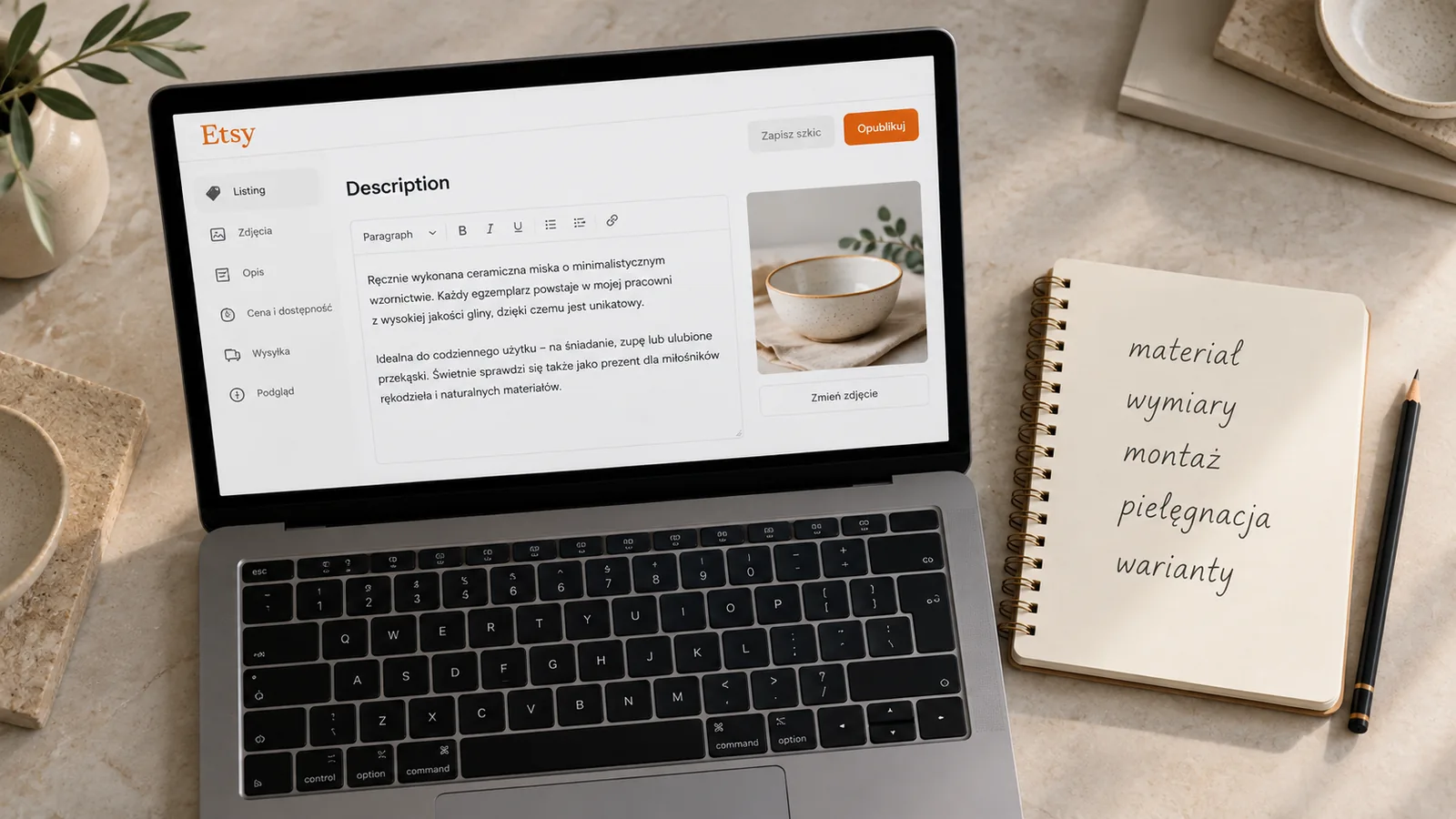
A useful Etsy product description explains exactly what the customer is buying, whether the selected variation meets their needs and what to expect when the order arrives. It does not need elaborate language. It needs to resolve the questions that photographs alone cannot answer.
I created CopperAndCraft and have developed its Etsy shop since 2018. With metal wall art, naming a colour is not enough: buyers need to understand the material, scale, surface and intended use. The approach below comes from that practical work. All sample wording is illustrative and must be completed with accurate information about your own product.
Start with the buyer’s questions
Before writing, review customer messages, notes from conversations and your product specifications. List the recurring questions: how many pieces the price includes, how to choose a size, whether the item arrives ready to install, what the finish looks like and what comes in the package. These questions are more useful than a list of flattering adjectives.
Arrange the answers in the order of a purchase decision. The buyer first identifies the product, checks whether it fits, chooses a variation and considers the ordering conditions. Your workshop’s story can support that journey, but it should not hide essential information. If you sell a set, explain the set before describing the inspiration behind the collection.
Make the opening sentences do useful work
Imagine answering a customer standing beside the product. Name the item, material, main use and contents of the order. Instead of “A unique decoration that transforms any interior”, try “A set of three decorative patinated copper panels, prepared for wall hanging”. Only use that wording if the customer really receives three panels prepared in that way.
Replace claims you cannot substantiate, such as “the highest quality on the market”, with a relevant fact about the material, construction, finishing process or available customisation. A buyer can assess a specific feature much more easily than another promise of luxury or uniqueness.
Use a repeatable structure, with product-specific details
A consistent template makes future listings easier to prepare and missing information easier to spot. The structure can repeat; the specifications and answers must describe the actual item. This is a useful starting point:
| Section | Buyer’s question | Information to include |
|---|---|---|
| What is included | What will I receive? | Product name, quantity and components. |
| Material and finish | What is it made from? | Base material, surface treatment and natural variation. |
| Dimensions | Will it fit? | Width, height, depth and measurement method. |
| Variations | Which option should I choose? | Differences between options and customisation limits. |
| Use and care | How do I use it? | Installation, maintenance and relevant restrictions. |
| Fulfilment | When and how will it arrive? | Production, shipping, packaging and next steps. |
Make dimensions and materials unambiguous
Explain whether measurements refer to one component, the complete set or a composition including gaps. With multi-part wall art, those are different things. Label the dimension order, such as width × height, and use it consistently in the description, size graphic and variation names.
Choose units that suit your audience. When giving both centimetres and inches, check the conversion and rounding. Do not imply greater precision than your manufacturing process supports. Use actual production data for weight, tolerances and suitable applications. A missing measurement needs to be taken, not guessed from a competitor’s listing.
Give every variation one consistent name
Compare the option in the purchase selector with its photograph and description. If one uses a collection name, another a number and another an informal colour label, the buyer cannot confidently match them. Choose a clear identifier and use it throughout the listing.
At CopperAndCraft, finish names help organise collections. They do not replace an explanation of the surface or the differences a natural process creates between individual pieces. The same principle applies to wood grain and ceramic glazes: a variation name identifies the option, while the description explains what it means in practice.
Explain installation and care before purchase
What seems obvious to a maker may be entirely unfamiliar to a customer. State whether installation requires additional components, whether they are included and where the instructions can be found. If the correct fixing depends on the wall or substrate, explain that rather than promising a universal solution.
Care instructions must match the finish. A lacquered surface, a waxed surface and untreated metal may need different guidance. Do not copy one set of instructions across all three. Give the essential actions and restrictions a buyer should understand without making them read a technical essay.
Use search terms to describe the product naturally
Etsy’s guide to listing descriptions explains that descriptions contribute to search and recommends a natural opening rather than a copied title or a string of keywords. This does not mean the description alone determines visibility. It works alongside the rest of the listing.
Check whether you use words the buyer understands. A distinctive collection name can stay, but put a recognisable product name beside it. “Copper Storm” identifies a finish; “wall panel”, “wall art” or “sample” explains the purchase. Avoid adding unrelated uses simply because a search phrase seems popular.
Replace a vague promise with a practical outline
Consider a made-to-order metal decoration. “A beautiful premium product, perfect for every home, available in many options” leaves almost every purchasing question unanswered. A more useful draft might read:
Decorative panel made from [material], with a [finish name] finish. The price includes [quantity and components]. Choose a size from the options; measurements refer to [measurement method]. The surface is created using [process], so [actual variation between pieces]. Installation: [details]. Production and shipping: [current conditions].
The brackets are prompts for verified information, not publishable copy. Once completed, read the description alongside the actual photographs. Remove details about options unavailable in this listing. If you offer bespoke orders, explain how customers can discuss them.
Translate meaning and check the data
When localising the CopperAndCraft catalogue from Etsy to Shopify, I worked through hundreds of titles and descriptions alongside measurement conversions. A shared glossary and a consistent source of product data were essential. Automated translation can speed up a first draft, but it must not invent material properties, certifications or delivery conditions.
Keep established collection names consistent and check specialist terms separately. Read the translated description as someone who has never seen the original. Is it clear what they can order and how to choose? For the same product in several markets, one approved specification should remain the reference.
Check the description, photographs and purchase options together
Good writing cannot resolve conflicting information. If the gallery shows three pieces but the price covers one, make the quantity clear throughout. If you offer personalisation, check how customers submit their details. A new size must not inherit incorrect measurements copied from another listing.
Ask someone unfamiliar with the product to explain what will arrive. Note where they need clarification. The Etsy audit guide provides a wider review framework, while the product photography guide helps you plan supporting images.
Improve existing descriptions in manageable groups
Choose a coherent product group, save the current versions and gather missing information. Correct factual errors and contradictions first, then organise the sequence, variations and wording. A more elegant sentence cannot compensate for a missing dimension.
The Etsy Listing Improvements package covers ten listings using the data and materials you provide. It includes organising existing photographs; a new photoshoot is separate. After publication, review customer questions and listing behaviour without attributing every change in sales to the new copy.
Need help with Etsy, Shopify or a business website?
Tell me about your project. I’ll reply personally.
Enquire about a consultation ↗US$90 excl. VAT / 60 minutes · By appointment